


Eliminate Muddy Tone: The Classic Standard Treble Bleed |
Treble Bleed Comparison |
||||||||||||
|---|---|---|---|---|---|---|---|---|---|---|---|---|---|
|
Why Use a Treble Bleed Circuit? The Standard (Parallel) circuit utilizes a resistor and capacitor wired in parallel. This configuration provides a classic, predictable frequency roll-off. It is the gold standard for players seeking that familiar, vintage “sparkle” when turning down, specifically suited for lower-output vintage pickups. |
|
Stop sacrificing your high-end clarity when you roll back your volume.
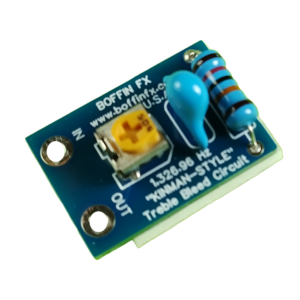
The Boffin FX Adjustable Treble Bleed is the ultimate tone-preservation tool. By acting as a high-pass filter, this circuit prevents the “muddy” tone associated with passive volume roll-off, ensuring your instrument remains articulate and bright at any volume level.
Engineered for precision, this circuit features a 1,592.4 Hz cut-off frequency—the sweet spot for maintaining maximum high-frequency retention. Whether you play glassy single coils or high-output humbuckers, this unit provides a balanced, professional response across the entire taper of your volume pot.
Why the Boffin FX Treble Bleed is the gold standard:
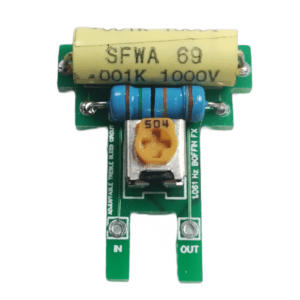
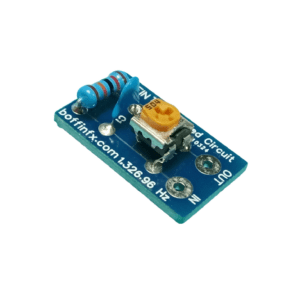
Precision Tuning: Equipped with an onboard 500K adjustable trimpot, allowing you to fine-tune the bleed intensity to match your specific pickup’s output and your personal tonal preference.
Universal Compatibility: Optimized for both single-coil and humbucker configurations (e.g., Suhr, Seymour Duncan, and vintage-spec pickups).
Engineered for Brightness: Designed specifically for high-output, high-treble applications where clarity is paramount.
Seamless Installation: Features a “peel-and-stick” adhesive backing for secure mounting inside your control cavity.
Easy Integration: Simple two-wire installation; just solder the input and output pads directly to your volume potentiometer.
Technical Specifications
Circuit Type: 0.001uF Capacitor / 500K Adjustable Trim Pot.
Cut-off Frequency: 1,592.4 Hz.
Dimensions: 28mm x 15mm (1.1″ x 0.6″).
Mounting: Integrated adhesive backing for clean, permanent installatio
Still not sure which circuit is right for your rig? Not all Treble Bleeds are created equal. Different topologies (Parallel vs. Series) drastically change how your volume pot feels. Read our Ultimate Guide to Treble Bleed Circuits.
Wiring Diagram

Treble Bleed Frequently Asked Questions
Why does my guitar tone get muddy when I turn down the volume?
Passive guitar circuits act as a low-pass filter. As you roll off the volume, the resistance increases, causing high frequencies to bleed to ground. Our circuits counteract this by providing an alternative path for those high frequencies.
Which circuit type should I choose for my pickups?
For vintage-output single coils, the Standard (Parallel) is ideal. If you use high-output humbuckers or desire a very consistent tone throughout the entire volume sweep, the Kinman (Series) is generally preferred. The Hybrid allows for fine-tuning the balance between these behaviors.
Can I install this if I am not an experienced technician?
Our circuits are designed for straightforward integration. If you are comfortable with basic soldering, you can easily install these directly onto your existing volume potentiometer lugs.
Does this work with my onboard Boffin FX Booster?
Yes. In fact, many players integrate our treble bleed circuits alongside our onboard MOSFET boosters to create a fully optimized signal chain that maintains both gain and tonal clarity at any volume level.

Reviews
There are no reviews yet.